
Your Face Changed Before Your Labs Did. Here Are the 7 Zones That Are Telling You Exactly Which Hormone Is Off — and What Your Mirror Is Diagnosing That Your Doctor Isn't Testing.
Your skin is not aging randomly. It is reporting — zone by zone, hormone by hormone. Here is how to read what your mirror has been telling you.

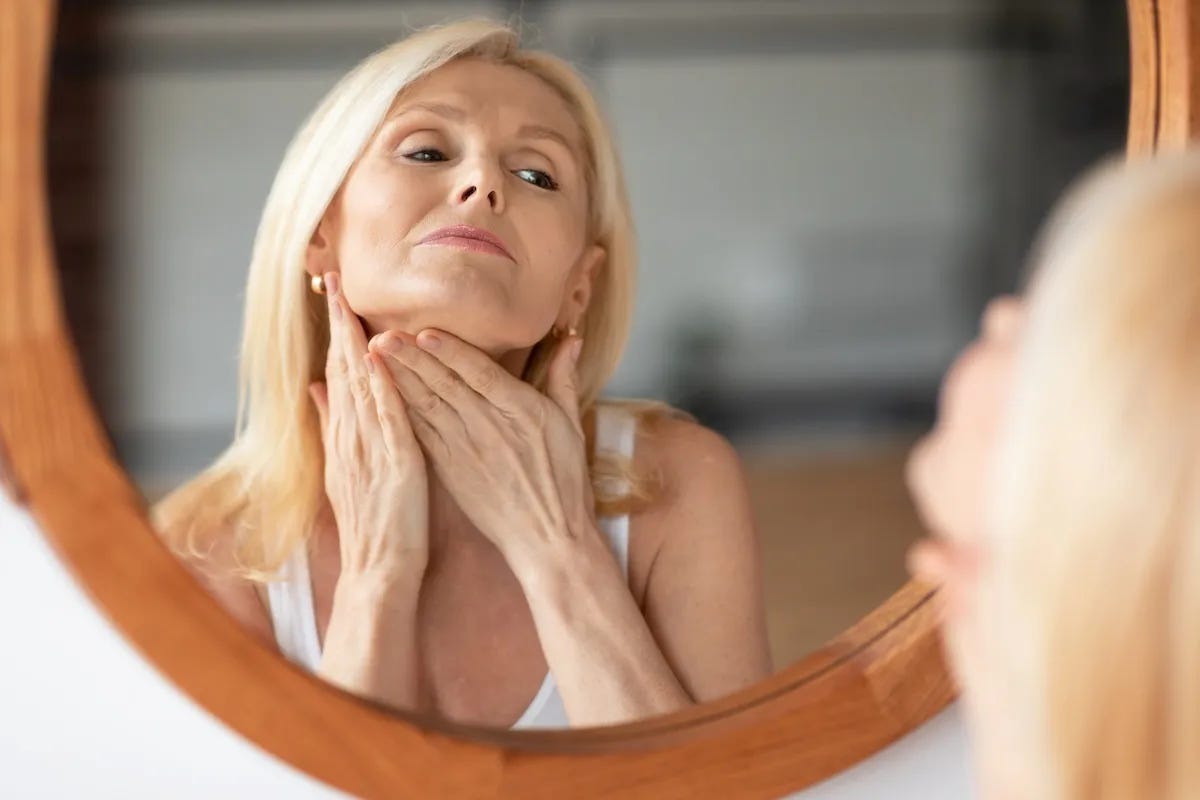
It is 7:14 AM. You are standing in your bathroom with the overhead light on. The kind of light that shows everything. You tilt your chin up slightly — the way you have started doing without thinking about it — and you look at your jawline. There are bumps there that were not there two years ago. Not exactly acne. Not exactly texture. Something in between that has no name, no clear cause, and no response to the cleanser you switched to in March.
You angle your face. The under-eye area is darker than it should be. You slept seven and a half hours. You drank water before bed. The darkness is there anyway. You touch the skin on your forehead — dry, even though you moisturized ten minutes ago. The moisturizer sits on top of your skin like it is not being absorbed. Like the skin underneath has changed the terms of the agreement.
I don’t look like myself anymore. When did this happen?
You pick up your phone. You open Sephora. You add a vitamin C serum — $42 — and a new retinol cream — $38. You already have a hyaluronic acid serum on the second shelf, a niacinamide toner behind the micellar water, and a peptide eye cream that cost $54 and has been open for eleven weeks. Your skincare spending over the last three months is somewhere north of $387. You have not kept an exact count because the exact count would bother you.
And here is the thing — each product did something. The retinol did smooth your texture after the peeling stopped. The vitamin C did brighten things slightly for about a week. The hyaluronic acid did plump up the surface when you applied it on damp skin. Each product performed exactly as advertised. None of them was a waste of money. But the underlying changes — the jawline bumps, the under-eye darkness that does not respond to sleep, the forehead dryness that does not respond to moisture, the way your cheeks look slightly deflated in certain lighting — those stayed.
They stayed because you have been treating the output without knowing about the input.
Your skincare routine is genuinely sophisticated. You research ingredients. You know what niacinamide does. You know that retinol increases cell turnover. You patch-tested the vitamin C serum on your wrist before using it on your face. You are not doing this carelessly. You are doing everything right — within the framework you were given. The problem is the framework. Nobody expanded it for you. Nobody told you the part that comes before the serum.
Your skin contains functional receptors for every major hormone in your body. Estrogen receptors. Androgen receptors. Cortisol receptors. Insulin receptors. Thyroid hormone receptors. These receptors are embedded in your keratinocytes, your fibroblasts, your melanocytes, your sebaceous glands, your hair follicles [1]. And here is the part that changes everything: those receptors are not distributed evenly. Different zones of your face have different receptor densities. Which means different zones respond to different hormones. Which means when a specific hormone shifts, a specific zone of your face changes — not randomly, not uniformly, but in a pattern that maps directly to the hormonal shift underneath.
Your face is not aging. It is reporting.
And there is a number that makes this undeniable. In a series of studies led by dermatologist Mark Brincat and colleagues, skin collagen content was measured in postmenopausal women using biopsy and hydroxyproline assay. The finding: women lose approximately 30 percent of their skin collagen within the first five years after menopause — at a rate of roughly 2.1 percent per year. But the critical part — the part that should change how you see yourself in the mirror tomorrow — is this: the collagen decline correlated directly with estrogen status, not chronological age. Women of the same age with different estrogen levels had measurably different collagen content [2][3]. Your collagen did not decline because you turned 47. It declined because your estrogen shifted. The retinol you bought stimulates collagen production from the outside. But it cannot replace what estrogen was doing from the inside.
The serum was never wrong. It was never the whole answer.
Your face has 7 zones. Each zone is governed by a specific hormone. Each zone changes in a specific, predictable way when that hormone shifts. You have been reading this report every morning — in the bathroom, under the overhead light, tilting your chin — without knowing the language.
Here is the language.
The Hormone Mirror
Your skin is the largest organ in your body. It is also the largest endocrine organ — meaning it does not just sit there passively receiving hormones from elsewhere. It contains its own hormone receptors, metabolizes its own hormones locally, and responds to systemic hormonal changes in real time [1][4].
Both estrogen receptor alpha (ERα) and estrogen receptor beta (ERβ) are expressed in human skin — in keratinocytes, fibroblasts, melanocytes, hair follicles, and sebaceous glands [1]. Androgen receptors are present in sebaceous glands and hair follicles, concentrated most densely in the lower face [5]. Thyroid hormone receptors regulate epidermal turnover and sebum production. Insulin receptors and IGF-1 receptors are present in keratinocytes and fibroblasts throughout the skin [6].
But here is the diagnostic signal: these receptors are not distributed evenly across the face. Androgen receptors are densest along the jawline and chin. Estrogen receptors are densest in the cheeks and perioral area. The periorbital skin — under and around the eyes — is the thinnest on the entire face, often less than 0.5mm, making it the first zone to reveal changes in cortisol, iron, and B12 status [7][8]. The forehead is heavily dependent on thyroid-regulated sebum production.
If aging were purely chronological — if time alone were driving the changes — every part of your face would age at the same rate, in the same way. It does not. The jawline changes differently from the forehead. The cheeks change differently from the under-eyes. The perioral area changes differently from the neck. The zone-specificity is the diagnostic signal. Each zone is reporting on a specific hormone.
The Hormone Mirror is the reframe: every morning when you look in the mirror, you are not seeing aging. You are seeing a real-time hormone status report that updates faster than bloodwork. Your doctor orders labs once or twice a year. Your mirror updates daily. You have been getting the report every morning for months — maybe years. You just did not know how to read it.
And for each zone, there are two layers. The first layer is internal — the hormone driving the change, the nutritional support, the targeted supplement. The second layer is external — the topical ingredient that works with the hormonal fix. Most women have only ever been given the second layer. This article gives you the first.
You do not have to address all 7 zones. Read the map. Identify your 2-3 most affected zones. Start there. The zones that are changing the most are the zones reporting the loudest.
The 7-Zone Map
Zone 1 — Jawline and Chin: The Androgen Readout
What changed: Breakouts along the jawline and chin — deep, cystic, sometimes just persistent small bumps that never fully clear. This is not the T-zone acne of your teens. This is U-zone acne that appeared in your late 30s or 40s. You may also be noticing coarser chin hairs — one or two at first, then a few more.
I haven’t had acne since high school. Why is my jawline doing this at 43?
Which hormone: Androgens — testosterone, DHEA, DHT. But not because your androgen levels increased. Because your estrogen and progesterone declined while your androgens stayed relatively stable. The ratio shifted. You are in a state of relative androgen excess — not from having too much testosterone, but from having less estrogen and progesterone to counterbalance it.
The mechanism: Androgen receptor density is highest in the jawline, chin, and lower cheeks — this is why hormonal acne appears in the U-zone rather than the T-zone [5][9]. It is the same receptor distribution that determines where men grow beards. Progesterone has natural anti-androgenic properties — it counterbalances androgen activity at the receptor level. In perimenopause, progesterone typically declines first, often 5-7 years before menopause. When progesterone drops, androgen receptors in the jawline that were always exposed to testosterone suddenly “hear” it more loudly. Sebum production increases in the U-zone. Pores clog. Hormonal acne appears in a woman who has not had a breakout in twenty years. Meanwhile, the enzyme 5α-reductase converts circulating testosterone into dihydrotestosterone (DHT) right at the skin level — and DHT binds to androgen receptors with 5 to 10 times greater affinity than testosterone [10].
What to do internally:
Support progesterone: vitamin B6 as P5P (pyridoxal-5-phosphate) 25-50mg daily — P5P is the active, bioavailable form that does not require liver conversion. Vitex (chasteberry) 400mg in the morning — supports pituitary signaling for progesterone production. Zinc picolinate or zinc bisglycinate 15-30mg daily — zinc inhibits 5α-reductase, reducing conversion of testosterone to the more potent DHT. An in vitro study published in the British Journal of Dermatologyfound zinc to be a potent inhibitor of 5α-reductase activity in human skin; at high concentrations, zinc completely inhibited the enzyme [11]. Ground flaxseed 2 tablespoons daily — lignans have mild anti-androgenic effects and support estrogen metabolism, which indirectly rebalances the androgen-to-estrogen ratio [12]. Cruciferous vegetables daily — broccoli, kale, Brussels sprouts — provide DIM and I3C for estrogen metabolism. Reduce refined sugar and high-glycemic foods — they spike insulin, and insulin stimulates ovarian and adrenal androgen production.
What to do externally:
Salicylic acid 2% — unclogs pores by dissolving the oil and dead skin inside the follicle, without stripping the surface. Niacinamide 5% — reduces sebum production and calms inflammation. This is the topical that works with the internal anti-androgen support — not instead of it. Zinc oxide sunscreen — anti-inflammatory and protective. A note: benzoyl peroxide treats bacterial acne effectively, but it is not the first-line topical for hormonal acne because hormonal acne is driven by the androgen-to-sebum pathway, not primarily by bacterial overgrowth.
Zone 2 — Cheeks: The Estrogen Readout
What changed: Volume loss — the “deflated” look that is subtle at first, then unmistakable. Broken capillaries you did not have before. Textural roughening where the skin used to be smooth. Loss of the glow you had in your 30s. Increased sensitivity or redness that your old moisturizer no longer handles.
Which hormone: Estrogen — specifically the decline in estradiol acting on both ERα and ERβ.
The mechanism: Estrogen receptors are densest in the cheeks [1][4]. Estrogen stimulates fibroblasts to produce type I and type III collagen, increases hyaluronic acid production (the molecule that holds moisture in the skin), and maintains elastin fiber integrity [1]. When estrogen declines, all three drop simultaneously. Collagen decreases — Brincat’s data shows 30 percent lost within five years after menopause, with a continued decline of roughly 2.1 percent per year [2][3]. Hyaluronic acid production decreases — the skin holds less moisture. Elastin fibers degrade — the skin loses elasticity and bounce. The cheeks, with their high estrogen receptor density, are where this shows first and most. Volume loss, dryness, visible capillaries from thinning dermal support, and that loss of luminosity that no highlighter quite replaces.
That’s when it changed. That’s when the glow went.
What to do internally:
Ground flaxseed 2 tablespoons daily — the richest dietary source of lignans, which support estrogen metabolism by shifting toward the protective 2-hydroxy estrogen pathway [12][13]. Fatty fish 2-3 times per week — salmon, sardines, mackerel — for omega-3 (EPA and DHA), which improve cell membrane integrity and reduce systemic inflammation that accelerates skin aging [14]. Vitamin C 500-1,000mg daily — a required cofactor for prolyl hydroxylase and lysyl hydroxylase, the enzymes that build stable collagen triple-helix structures. Without adequate vitamin C internally, your body cannot form collagen properly, regardless of what you put on your skin [15]. Collagen peptides 10-15g daily — provides glycine, proline, and hydroxyproline, the amino acid building blocks for collagen synthesis. Vitamin E 200-400 IU — antioxidant protection for skin lipid membranes.
What to do externally:
Retinol 0.3-0.5% — start low, apply every other night initially. Retinol stimulates collagen production from the outside. It works. But it works better when the inside is also supplied — the retinol and the internal vitamin C and protein are multipliers, not alternatives. Vitamin C serum 10-20% L-ascorbic acid — topical collagen stimulation plus photoprotection. This is the serum you already bought. It was not wrong. It was the second layer. Hyaluronic acid serum — draws moisture into estrogen-depleted skin that is producing less of its own. Sunscreen, daily, always — UV radiation accelerates the collagen degradation that estrogen decline already started. Non-negotiable.
Zone 3 — Under-Eyes: The Cortisol and Iron Readout
What changed: Darkness that does not respond to eight hours of sleep. Puffiness that persists past noon. Hollowing under the orbital bone. Fine lines that seem to deepen weekly.
I slept well. I drank water. Why do I still look exhausted?
Which hormones: Cortisol, iron, and B12. This zone is a multi-system readout.
The mechanism: The periorbital area is the thinnest skin on your face — often less than 0.5mm thick, compared to 1.5-2mm elsewhere [7][8]. It has minimal subcutaneous fat and fewer sebaceous glands. This extreme thinness means it reveals subcutaneous changes first — before any other zone on your face.
Chronic elevated cortisol impairs microcirculation and can cause fluid retention — producing periorbital puffiness that no amount of sleep resolves. Elevated cortisol also degrades collagen and weakens blood vessels, and when blood flow slows through the delicate vascular network under ultra-thin periorbital skin, venous congestion produces the dark, bruised appearance [16]. Iron deficiency adds another layer: when ferritin is low (even if hemoglobin is still “normal”), reduced oxygen-carrying capacity means deoxygenated blood appears darker through that thin skin [17]. B12 deficiency can contribute periorbital hyperpigmentation through increased melanin synthesis [18].
You can sleep perfectly and hydrate perfectly — if cortisol is chronically elevated and ferritin is below 40 ng/mL, the darkness stays. The eye cream manages the appearance. The internal fix addresses the cause.
What to do internally:
For cortisol: magnesium glycinate 300-400mg at bedtime — the glycinate form is well-absorbed and crosses the blood-brain barrier, supporting both sleep quality and cortisol regulation; magnesium oxide is poorly absorbed and acts primarily as a laxative [19]. Ashwagandha KSM-66 300mg in the morning — the KSM-66 extract is the most clinically studied form for cortisol reduction. Morning light exposure within 30 minutes of waking — resets the cortisol curve so it peaks correctly in the morning and declines by evening. Protein within 60 minutes of waking — stabilizes blood sugar and prevents the cortisol rescue spike that occurs when the body has to manufacture emergency glucose.
For iron: test ferritin, not just hemoglobin. Hemoglobin can be “normal” while ferritin is depleted — and ferritin below 40 ng/mL can produce visible under-eye changes even in the absence of clinical anemia. If ferritin is low: increase iron-rich foods — red meat, dark leafy greens, lentils. Pair plant-based iron sources with vitamin C to improve absorption. Do not supplement iron without testing — iron overload is dangerous and iron is one of the few nutrients where more is not better.
For B12: test serum B12. If below 400 pg/mL: methylcobalamin 1,000mcg sublingual — the methylated form is bioavailable and does not require the conversion step that cyanocobalamin does.
What to do externally:
Caffeine eye cream — temporarily constricts blood vessels, reducing the dark appearance. Vitamin K cream — supports coagulation and reduces periorbital discoloration. Cold compresses in the morning — mechanical vasoconstriction. But understand this clearly: if cortisol is chronically elevated and ferritin is low, no eye cream resolves this. The $54 peptide eye cream is addressing the surface layer of a three-layer problem. Give it the internal foundation and it will perform far better.
Zone 4 — Forehead: The Thyroid Readout
What changed: Persistent dryness despite moisturizing. Flaking. Rough texture that you can feel when you run your fingers across it. Horizontal lines deepening faster than expected. And — critically — thinning of the outer third of your eyebrows.
Which hormone: Thyroid — T3 and T4.
The mechanism: Thyroid hormones regulate epidermal cell turnover and sebaceous gland activity throughout the skin, but the forehead is particularly affected because it is highly sebum-dependent [20]. When T3 drops — even within the “normal” lab range — epidermal turnover slows. Dead skin cells accumulate. Sebum production decreases. The forehead becomes dry and rough despite a moisturizer that worked perfectly two years ago. The moisturizer did not change. Your thyroid output did.
The lateral eyebrow — the outer third — has the shortest hair growth cycle on the face and is often the first visible casualty of suboptimal thyroid function. This thinning is known as Queen Anne’s sign (also called the Hertoghe sign), and it was first described as a clinical indicator of hypothyroidism over a century ago [21][22]. It often appears before thyroid labs become officially “abnormal” — because the lab reference range for TSH is broad enough that a woman can be functionally hypothyroid with technically “normal” labs. If your outer eyebrows are thinning and your forehead is dry regardless of what you apply, the thyroid should be on the list.
What to do internally:
Selenium 100-200mcg daily — or 2-3 Brazil nuts daily, which provide approximately 100 percent of the RDA. Selenium is required for the deiodinase enzymes that convert inactive T4 into active T3 [23]. Without adequate selenium, you can produce T4 just fine but fail to convert it into the T3 your cells actually use. Brazil nuts provide selenomethionine — a food-form selenium with superior bioavailability compared to supplement forms. Do not exceed 4 Brazil nuts daily — selenium toxicity is real. Zinc 15-30mg — also required for T4-to-T3 conversion. Iodine from food sources — seaweed, fish, dairy — but do not mega-dose iodine supplements, especially if you have autoimmune thyroid disease (Hashimoto’s), as excess iodine can worsen thyroid inflammation. Adequate carbohydrates — 100-175g per day for most women — because carbs are required for T4-to-T3 conversion. Chronic low-carb dieting suppresses this conversion and can worsen thyroid symptoms.
Test the full thyroid panel: TSH, free T3, free T4, TPO antibodies, and reverse T3. TSH alone is not enough.
What to do externally:
Gentle exfoliation 1-2 times per week — lactic acid 5-10% or polyhydroxy acids (PHAs), which are gentler than glycolic acid for already-dry skin. The goal is to assist the cell turnover that suboptimal thyroid is slowing down. Ceramide-rich moisturizer — rebuilds the lipid barrier that reduced sebum production has compromised. Hyaluronic acid under the ceramide layer — draws moisture into the skin before the ceramide seals it in. Avoid harsh, stripping cleansers — the barrier is already compromised. It needs protection, not further stripping.
Zone 5 — Around the Mouth (Perioral Area): The Estrogen Readout, Part 2
What changed: Vertical lip lines — sometimes called barcode lines — forming above the upper lip. Loss of lip border definition. Thinning of the upper lip. Perioral dryness and fine lines radiating outward.
Which hormone: Estrogen.
The mechanism: The perioral area has high estrogen receptor density [1]. Estrogen maintains collagen and hyaluronic acid in the dermis around the mouth. When estrogen declines, dermal thinning occurs — and the vertical lines form along the path of repeated muscle movement from the orbicularis oris muscle (the circular muscle you use every time you speak, eat, drink, or pucker). The collagen scaffolding that held the skin smooth around the mouth lost its estrogen-driven maintenance. The upper lip thins because the vermilion border loses its collagen support [4].
This is accelerated by UV exposure and smoking history — but the hormonal component is primary. You did not “get lip lines because you got old.” You got lip lines because the structural protein that held the skin taut around your mouth lost its primary hormonal driver.
What to do internally:
Same estrogen-support protocol as Zone 2 — ground flaxseed, omega-3, vitamin C 500-1,000mg, collagen peptides 10-15g, vitamin E. Hydration — perioral line formation accelerates with chronic dehydration, which compounds the hyaluronic acid loss from estrogen decline.
What to do externally:
Retinol around the mouth — lower concentration than elsewhere on the face, as this area is sensitive. Start with 0.25%. Peptide cream — signal peptides like palmitoyl pentapeptide-4 (Matrixyl) stimulate fibroblast activity in the perioral dermis. Hyaluronic acid lip treatment — replaces some of what declining estrogen is no longer producing. Lip balm with SPF — UV exposure accelerates perioral collagen loss, and most women protect the face but forget the lips.
Zone 6 — Neck and Décolletage: The Cumulative Readout
What changed: Crepey texture. “Necklace lines” deepening. Redness. Mottled pigmentation. Visible skin thinning.
Which hormones: Estrogen plus UV — cumulative.
The mechanism: The neck and décolletage have thinner dermis and fewer sebaceous glands than the face [24]. This area is chronically under-protected — you apply sunscreen to your face and stop at the jawline. The combination of estrogen-driven collagen loss plus decades of accumulated UV photoaging produces changes here that may appear before they appear on the face itself. The neck is the cumulative readout. It reflects your total lifetime estrogen plus UV exposure history.
What to do internally:
Same systemic collagen and antioxidant support as Zones 2 and 5 — omega-3 for anti-inflammatory protection of UV-damaged skin, vitamin C for collagen synthesis and photoprotection from the inside, collagen peptides for amino acid supply.
What to do externally:
Extend every product you use on your face to the neck and chest. This is the single most common skincare gap — women apply retinol, vitamin C, hyaluronic acid, and sunscreen to the face and stop at the jawline. The neck needs all of it. Retinol on the neck — but lower concentration than face, 0.25-0.3%. Neck skin is thinner and more reactive. Vitamin C serum on the décolletage. Sunscreen every single day on the neck and chest — this is the number one most neglected zone in every skincare routine, and it is the zone that ages fastest because of it.
Zone 7 — Overall Tone and Color: The Systemic Readout
What changed: Overall pallor — a “washed out” appearance. Persistent redness or flushing. Uneven tone. A waxy or yellowish cast that was not there before.
Which systems: Iron, B12, histamine, estrogen fluctuations. This is not one zone — it is the overall canvas.
The mechanism: Pallor — iron deficiency reduces hemoglobin, which reduces the red tone in skin. The face looks drained because it is, biochemically [17]. Waxy or yellowish cast — B12 deficiency impairs red blood cell formation, producing megaloblastic changes that affect skin color [18]. Persistent redness or flushing — histamine intolerance (mast cell degranulation causes vasodilation and facial flushing) or estrogen-fluctuation-driven vasomotor instability, common during perimenopause [25]. Uneven tone — patchy melanocyte stimulation from hormonal shifts. Melasma — the mask of pregnancy — results from the interaction of estrogen, progesterone, and UV, and commonly flares during perimenopause and with hormone therapy or oral contraceptives [26].
What to do internally:
Test ferritin and B12 — do not guess. Both have specific, testable markers, and the treatment is different for each. Address deficiencies per test results. For histamine: quercetin 500mg twice daily — acts as a mast cell stabilizer, reducing histamine release. Vitamin C 1-2g daily — lowers blood histamine levels. DAO (diamine oxidase) enzyme before high-histamine meals if histamine intolerance is suspected. For melasma: aggressive sun protection is non-negotiable — even minor UV exposure can trigger melanocyte activation in hormonally sensitized skin.
What to do externally:
For uneven tone: tranexamic acid serum — inhibits melanin transfer and is one of the newer, well-evidenced options for hormonal pigmentation. Vitamin C serum — inhibits tyrosinase, the enzyme that produces melanin. Niacinamide 5% — inhibits melanosome transfer to keratinocytes, reducing visible pigmentation. For redness: azelaic acid 10-15% — anti-inflammatory, anti-redness, and a mild 5α-reductase inhibitor [11]. Sunscreen — prevents UV-triggered melanocyte and mast cell activation.
The Inside-Out Protocol
You now have 7 zones. You do not need to address all 7. That is not the point. The point is the map. Here is how to use it.
Step 1 — Identify. Stand in front of the mirror tomorrow morning. Not the quick glance. The real look. Which 2-3 zones are changing the most? Those are the zones reporting the loudest. Start there.
Step 2 — Address the inside first. For each of your zones, look at the “What to Do Internally” section. These are the nutritional and supplemental foundations that address the hormone driving the change. Start these first. Give them 4-8 weeks. The skin is a slow organ — it takes one full cell turnover cycle to see internal changes reflected externally. That cycle is approximately 28 days in your 20s and stretches to 40-50+ days after 40. The inside needs time. Give it the time.
Step 3 — Support with the outside second. For each of your zones, look at the “What to Do Externally” section. These are the topical ingredients that work with the hormonal fix. They are not replacing the inside work. They are amplifying it. The retinol works better when collagen synthesis is supported internally with vitamin C and amino acids. The vitamin C serum works better when vitamin C intake is adequate from food and supplements. The inside and outside are multipliers, not alternatives.
Step 4 — Recheck at 8-12 weeks. After 8-12 weeks of combined inside-out support, reassess the zones. Some will have improved. Some may have revealed the next zone that needs attention — because the loudest zone was masking a quieter one underneath. The map is iterative. You use it over time.
Your skincare routine was never wrong. It was the second layer of a two-layer system. You now have both layers.
The Hormone Mirror Plate
One dinner. All 7 zones supported simultaneously from the inside. You can make this tonight.
Wild salmon fillet (4-6 oz): Omega-3 EPA and DHA for anti-inflammatory support across every zone [14]. Complete protein providing the amino acids your body uses to build collagen. Vitamin D — a hormone precursor. Selenium — thyroid support for Zone 4 [23]. Astaxanthin — the carotenoid pigment that gives salmon its pink color and one of the most potent antioxidants measured for skin, with singlet oxygen quenching capacity far exceeding standard antioxidants.
Roasted broccoli or kale (1-2 cups): DIM and I3C for estrogen metabolism supporting Zones 1, 2, 5, and 6 [27]. Vitamin C for collagen synthesis. Sulforaphane — activates the Nrf2 pathway, your body’s master antioxidant switch. Fiber for gut-skin axis support — intestinal health directly influences estrogen clearance through the estrobolome.
Medium sweet potato: Complex carbohydrate for thyroid T4-to-T3 conversion — Zone 4 [20]. Beta-carotene — converted to vitamin A in the body, supporting skin cell turnover from the inside. Retinol’s dietary cousin. Fiber.
2 tablespoons ground flaxseed (sprinkled on the vegetables): Lignans for estrogen metabolism [12][13]. ALA omega-3. Fiber for estrobolome support. Four mechanisms from a single ingredient that costs fifteen cents.
Olive oil drizzle (1-2 tablespoons): Vitamin E for fat-soluble antioxidant protection of skin lipid membranes. Oleocanthal — a natural anti-inflammatory compound. Healthy fat for hormone synthesis and fat-soluble vitamin absorption.
After dinner: magnesium glycinate 300mg. Cortisol regulation for Zone 3 [19]. Sleep support. A cofactor in over 300 enzymatic reactions in the body, including those involved in overnight skin repair.
Every ingredient in this meal is a deposit into at least 3 zones simultaneously. One plate. Seven zones addressed. This is what eating for your skin from the inside actually looks like — not a theoretical exercise, but a dinner you would genuinely enjoy making tonight.
This meal is the Plate Formula — protein plus healthy fat plus complex carb plus vegetables. The same architecture at every meal, every day. And it is the foundation of the Reset.
The Complete Hormonal Foundation
The Plate Formula described above is not a one-meal concept. It is a daily structure. And it is the core of The 21-Day Hormone Reset for Women.
The Reset addresses the hormones driving each zone in biological sequence — not all at once, not randomly, but in the order that produces the strongest foundation. Week 1 resets cortisol — Zone 3. The under-eye area begins to respond as the cortisol curve normalizes, sleep deepens, and inflammation calms. Week 2 supports estrogen and progesterone balance — Zones 1, 2, 5, and 6. The jawline calms. The cheeks begin to firm. The perioral area gets collagen support. Week 3 supports thyroid function — Zone 4. The forehead starts to normalize. Sebum production begins to recover. The lateral eyebrows may begin to fill. The sequence matters because cortisol disrupts progesterone, which disrupts estrogen balance, which disrupts thyroid. You cannot fix the downstream hormones while the upstream one — cortisol — is still elevated. The Reset handles this in the correct order.
Everything in this article is free. The 7-Zone Map is yours. The Inside-Out Protocol is yours. The Hormone Mirror Plate is yours tonight. The Reset is for the woman who reads this and thinks: I see which zones are reporting. I want the complete hormonal foundation addressed — not one zone at a time, but all of them, in the biological sequence that actually works. I want sixty-three meals planned, grocery lists included, and the structure that takes this from understanding to daily practice.
→ The 21-Day Hormone Reset for Women
If your skin changes accelerated during a period of chronic restriction or extreme dieting — if under-eating has been the pattern — your body may be missing the raw materials for collagen synthesis entirely. The Metabolic Freedom Method rebuilds the metabolic foundation that makes every nutrient in this article absorbable.
Read the Mirror Differently
It is 7:14 AM. You are in the same bathroom. The same overhead light is on. You tilt your chin up the same way.
But you see something different now.
The jawline bumps — that is Zone 1. The androgen readout. Progesterone declined, and the androgen receptors in the lower face are hearing testosterone they were always exposed to but never responded to before. You do not have too much testosterone. You have less progesterone. The flaxseed and the zinc and the vitex are the first layer. The salicylic acid is the second.
The under-eye darkness — that is Zone 3. The cortisol and iron readout. The periorbital skin is the thinnest on your face, and it is showing you what the cortisol curve and the ferritin level look like right now — in real time. The magnesium and the morning protein and the ferritin test are the first layer. The caffeine eye cream is the second.
The forehead dryness — that is Zone 4. The thyroid readout. T3 regulates epidermal turnover and sebum production, and when it drops, the skin accumulates dead cells and the moisture barrier thins. The Brazil nuts and the zinc and the full thyroid panel are the first layer. The ceramide moisturizer is the second.
The cheeks — that is Zone 2. The estrogen readout. Collagen is declining at 2.1 percent per year because estrogen shifted, not because of chronological age. The flaxseed and the vitamin C and the collagen peptides are the first layer. The retinol and the vitamin C serum you already own are the second.
You see each zone. You know which hormone governs it. You know the inside fix and the outside support. You have the map.
Tomorrow morning, you will stand in the same bathroom, under the same light, and tilt your chin the same way. But you will not see damage. You will not see decline. You will see a diagnostic report from the most sophisticated organ in your body — delivered to you in real time, every single day, for free. Your mirror has been telling you the whole time.
Now you know how to listen.
That’s not aging. That’s estrogen. That’s cortisol. That’s thyroid. And I know exactly what to do about it.
The Hormone Mirror. It fires every morning. Every time you look at your face, you hear the report. Not anxiety. Information. Not decline. Direction. Not aging — reporting.
The serum was never wrong. It was the second layer. Now you have the first.
References
[1] Thornton MJ. “Estrogens and aging skin.” Dermato-Endocrinology. 2013;5(2):264-270. doi:10.4161/derm.23872.
[2] Brincat M, Moniz CJ, Studd JW, Darby A, Magos A, Emburey G, Versi E. “Long-term effects of the menopause and sex hormones on skin thickness.” British Journal of Obstetrics and Gynaecology. 1985;92:256-259.
[3] Brincat M, Kabalan S, Studd JW, Moniz CF, de Trafford J, Montgomery J. “A study of the decrease of skin collagen content, skin thickness, and bone mass in the postmenopausal woman.” Obstetrics & Gynecology. 1987;70:840-845.
[4] Verdier-Sévrain S, Bonté F, Gilchrest B. “Biology of estrogens in skin: implications for skin aging.” Experimental Dermatology. 2006;15(2):83-94.
[5] Thiboutot D, Gilliland K, Light J, Lookingbill D. “Androgen metabolism in sebaceous glands from subjects with and without acne.” Archives of Dermatology. 1999;135(9):1041-1045.
[6] Hermanns-Lê T, Scheen A, Piérard GE. “Acanthosis nigricans associated with insulin resistance: pathophysiology and management.” American Journal of Clinical Dermatology. 2004;5:199-203.
[7] Pilkington SJ, Belden S, Miller RA. “The tricky tear trough: a review of topical cosmeceuticals for periorbital skin rejuvenation.” Journal of Clinical and Aesthetic Dermatology. 2015;8(11):39-47.
[8] Ha RY, Nojima K, Adams WP Jr, Brown SA. “Analysis of facial skin thickness: defining the relative thickness index.” Plastic and Reconstructive Surgery. 2005;115(6):1769-1773.
[9] Thiboutot D, Bayne E, Thorne J, Gilliland K, Flanagan J, Shao Q, et al. “Immunolocalization of 5alpha-reductase isozymes in acne lesions and normal skin.” Archives of Dermatology. 2000;136(9):1125-1129.
[10] Ceruti JM, Leirós GJ, Balañá ME. “Androgens and androgen receptor action in skin and hair follicles.” Molecular and Cellular Endocrinology. 2018;465:122-133.
[11] Stamatiadis D, Bulteau-Portois MC, Mowszowicz I. “Inhibition of 5α-reductase activity in human skin by zinc and azelaic acid.” British Journal of Dermatology. 1988;119(5):627-632.
[12] Brooks JD, Ward WE, Lewis JE, et al. “Supplementation with flaxseed alters estrogen metabolism in postmenopausal women to a greater extent than does supplementation with an equal amount of soy.” American Journal of Clinical Nutrition. 2004;79(2):318-325.
[13] Buck K, Zaineddin AK, Vrieling A, et al. “Meta-analyses of lignans and enterolignans in relation to breast cancer risk.” American Journal of Clinical Nutrition. 2010;92(1):141-153.
[14] Rhodes LE, Shahbakhti H, Azurdia RM, et al. “Effect of eicosapentaenoic acid, an omega-3 polyunsaturated fatty acid, on UVR-related cancer risk in humans. An assessment of early genotoxic markers.” Carcinogenesis. 2003;24(5):919-925.
[15] Pullar JM, Carr AC, Vissers MCM. “The roles of vitamin C in skin health.” Nutrients. 2017;9(8):866.
[16] Freitag FM, Cestari TF. “What causes dark circles under the eyes?” Journal of Cosmetic Dermatology. 2007;6(3):211-215.
[17] Sheth PB, Shah HA, Dave JN. “Periorbital hyperpigmentation: a study of its prevalence, common causative factors and its association with personal habits and other disorders.” Indian Journal of Dermatology. 2014;59(2):151-157.
[18] Brescoll J, Daveluy S. “A review of vitamin B12 in dermatology.” American Journal of Clinical Dermatology. 2015;16(1):27-33.
[19] Pickering G, Mazur A, Trousselard M, et al. “Magnesium status and stress: the vicious circle concept revisited.” Nutrients. 2020;12(12):3672.
[20] Safer JD. “Thyroid hormone action on skin.” Dermato-Endocrinology. 2011;3(3):211-215.
[21] Taguchi H, Nishioka H. “Eyebrow loss and the Queen Anne sign in hypothyroidism.” QJM: An International Journal of Medicine. 2023;116(12):1029-1030.
[22] Hertoghe E. “The sign of Hertoghe: lateral eyebrow thinning in hypothyroidism.” Clinical description, cited in keratin.com review of historical dermatological signs, 2025.
[23] Köhrle J. “Selenium and the thyroid.” Current Opinion in Endocrinology, Diabetes and Obesity. 2015;22(5):392-401.
[24] Calleja-Agius J, Brincat M, Borg M. “Skin connective tissue and ageing.” Best Practice & Research Clinical Obstetrics and Gynaecology. 2013;27(5):727-740.
[25] Maintz L, Novak N. “Histamine and histamine intolerance.” American Journal of Clinical Nutrition. 2007;85(5):1185-1196.
[26] Rajanala S, Maymone MBC, Vashi NA. “Melasma pathogenesis: a review of the latest research, pathological findings, and investigational therapies.” Dermatology Online Journal. 2019;25(10).
[27] Higdon JV, Delage B, Williams DE, Dashwood RH. “Cruciferous vegetables and human cancer risk: epidemiologic evidence and mechanistic basis.” Pharmacological Research. 2007;55(3):224-236.
This is fascinating! I appreciate how you address both the internal and external with these protocols. I’ve been following some of these supplementation suggestions for concerns you’ve addressed in other articles, but I found a few gaps I can fill to help my skin. Thank you
Is any of this contraindicated for women already on HRT? Just looked up chasteberry and it can interfere with hormones. Thanks.